Tuesday, 7 January 2020

European Capacity Building Initiative- Regional Workshop


ECBI Workshop Participants 2019 (Tobago)

European Capacity Building Initiative’s (ECBI) First Regional Workshop for the Caribbean on climate change negotiation took place on October 30th and 31st 2019 at the Magdalena Grand Beach and Golf Resort in Lowlands, Tobago. Chaired by the Director of the  ECBI, Dr. Benito Müller, participants were exposed to a number of essential presentations and sessions on climate change efforts. Sir Carlos Fuller, International and Regional Liaison Officer of the Caribbean Community Climate Change Center and a senior negotiator for Belize started the workshop with a session on the science of climate change. Sir Fuller also presented on “Loss and Damage Due to Climate Change”, which was particularly relevant as it is an item on the agenda for the United Nations Framework Convention on Climate Change (UNCCC).
Following Sir Fuller, Mr. Kishan Kumarsingh, Head of the Multilateral Environmental Agreements (MEA) Unit at the Ministry of Planning and Development (MPD) and lead Climate Change Negotiator for Trinidad and Tobago presented on the politics of climate change and gave a synopsis of the geopolitics of climate change and the history of various MEAs and challenges of dealing with climate change on the international forefront. 
Some of the key points to note during Mr. Kumarsingh’s presentation were:

  • Geopolitics- each country has the right to development and right to its resources
  • Energy drives economies but recently it has been seen that you can realize economic growth without a concomitant rise in greenhouse gas (GHG) emissions
  • Richer countries of the North have greater historical responsibility due to their level of emissions
  • This is unfortunate as there is a great disparity between the developed and developing countries, and it is the developing countries of the South that are more susceptible to the impacts of climate change
  • There is no international police and countries cannot be forced to act, given the principle of sovereignty, so therefore all actions are solely based on political will.
  • It is of the interest of politicians and governments to address climate change as it has been leading to socioeconomic destruction
Ms. Rueanna Haynes of Trinidad and Tobago presented on Transparency under the Paris Agreement which was then followed by Dr. Müller’s final segment on Article 6 of the Paris Agreement for a more comprehensive understanding of the mechanisms for international cooperation when implementing the NDCs. These presentations were integral to the mock negotiation sessions as the information provided was key to making the most informed decisions. Participants were given various countries, mostly from the Alliance of Small Island States (AOSIS), and were engaged in a highly realistic negotiation session which was chaired by Mr. Kumarsingh. To lend even more realism, Mr. Kumarsingh was carded to be the actual chair for the particular item of the mock session’s agenda in COP25. The sessions were as close to the COP negotiations that novices would have been able to experience as there were debates with senior negotiators on real topics.

Snapshot of participants during workshop activity

ECBI Participants pose with their Certificate of Completion


Wednesday, 18 December 2019

Twenty Fifth Conference of Parties of the United Nations Framework Convention on Climate Change- Madrid


The Twenty Fifth Conference of Parties of the United Nations Framework Convention on Climate Change (UNFCCC) convened in Madrid, Spain during the period November 27 to December 15, 2019 under the theme of “The Time to Act- now.” The other Governing Bodies and Constituted Bodies also met during this period. Trinidad and Tobago was represented at the meetings by Mr. Ric Ali, Deputy Permanent Secretary, Ministry of Planning and Development, Mr. Kishan Kumarsingh, Head, Multilateral Environmental Agreements Unit, Ministry of Planning and Development, Ms. Sindy Singh, Climate Change Specialist, Ministry of Planning and Development, Ms. Crystal Lawrence, Tobago House of Assembly and Ms. Kristin Qui. 


 Some key issues on the Agenda of these meetings included the review of the Warsaw International Mechanism on Loss and Damage, Article 6 negotiations for markets and non-market mechanisms, and gender and climate change. The Conference resulted in the Chile Madrid Time for Action suite of decisions. Parties were unable to reach consensus on key issues related to Article 6 and further deliberations are expected at the next session. 


More information regarding this event will be shared subsequently. 

#MinistryofPlanningandDevelopment #EnvironmentalPolicyandPlanningDivision #EPPD #EnvironmentalPrideIsNationalPride 


Wednesday, 11 December 2019

Official Handover of Enforcement Officer Resources

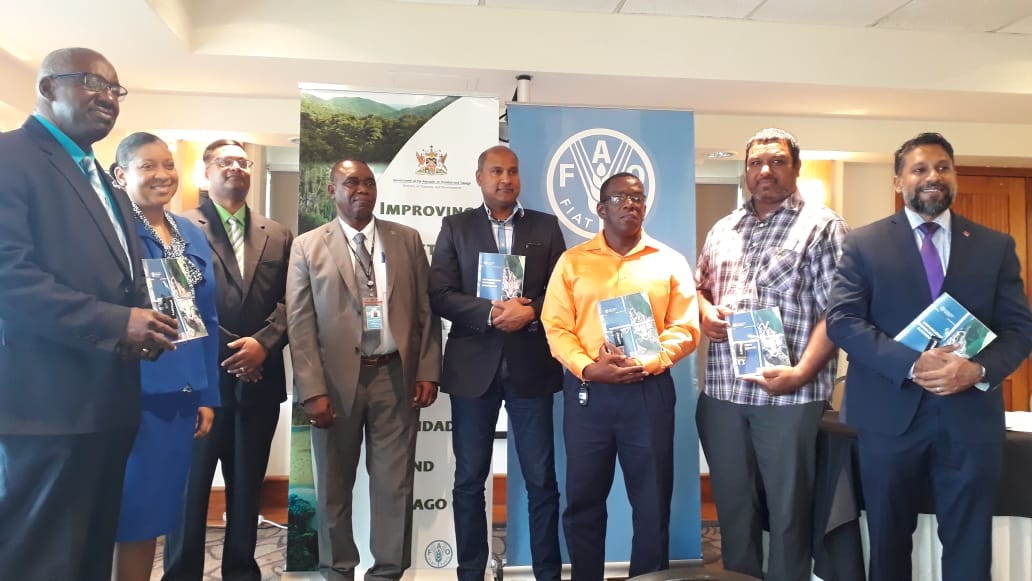
On Wednesday December 11th, 2019 the Food and Agriculture Organisation Food of the United Nations (FAO/UN) held the official handover of Enforcement Officer Resources stemming from the Improving Forests and Protected Areas Management (IFPAM) Project. 

The handover represents the results of the ongoing efforts of the IFPAM project, in particular three (3) workshops held under the auspices of the Environmental Management Authority (EMA) in collaboration with the FAO/UN between June and August of 2018 at Port-of-Spain, San Fernando and Tobago.  The theme of those workshops was “Boosting our frontline: Improving enforcement of laws for environmental management.”

The objectives of the workshops, were to:
    • Improve knowledge of the impacts of deleterious actions on the health of ecosystems and livelihoods
    • Build and strengthen networks to enable improved collaboration among governmental organisations.
    • Improve knowledge of the Environmental Management Act 2000 Ch. 35:05 and rules; the Forest Act Ch. 66:01; the Conservation of Wildlife Act Ch. 67:01 and other relevant laws, in particular the State Lands Act Ch.57:01 and The Town and Country Planning Act Ch.35:01.
As part of this initiative, three (3) tangible outputs were created;  
  1. An enforcement officer’s guidebook, which lists some of the most applicable legislation, additionally, the guide explains at a basic level the methodology for coordinating among the various enforcement agencies and the fundamentals for laying charges under current legislation.
  2. Standard Operating Procedures have been developed which include photographs of all the species to afford easy identification as well as a list of contacts of the relevant regulatory authorities.
  3. Along with a wallet sized, weatherproofed guide which outlines the ten basic steps for carrying out an investigation. 

Deputy Permanent Secretary of the Ministry of Planning and Development, Ms. Melanie Noel addressing the audience

Mr. Steve Lalbeharry, Regional Coordinator, Emergency Response & Investigations, EMA Describing the Enforcement Materials

Representatives of Different Agencies with Copies of their Enforcement Materials