Showing posts with label Floyd Homer. Show all posts

Wednesday, 22 May 2019

7th Session of the Intergovernmental Platform for Biodiversity and Ecosystem Services (IPBES-7)


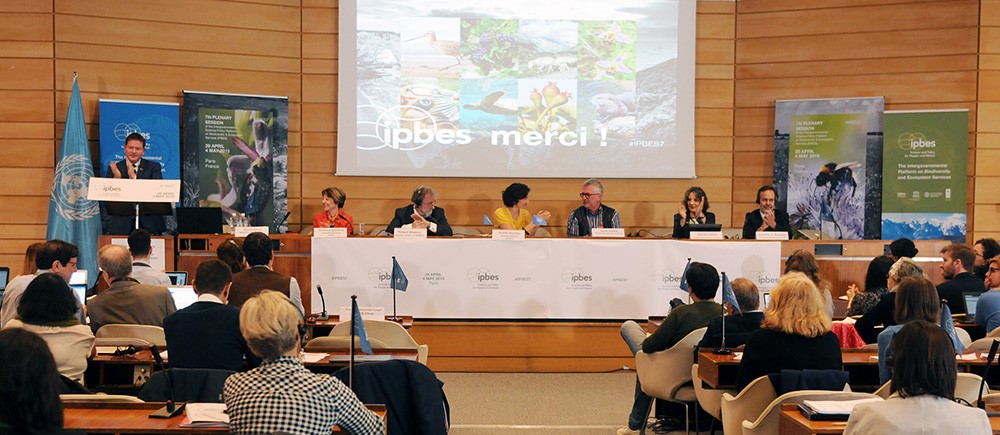
Launch of the Global Assessment Report in Paris 
(Photo courtesy: http://enb.iisd.org/ipbes/7-plenary/)

The Intergovernmental Science-Policy Platform for Biodiversity and Ecosystem Services (IPBES) ended its one-week 7th Plenary meeting in Paris on Saturday 4th May, 2019. The major outcome of this session was the launch of the Global Assessment Report on Biodiversity and Ecosystem Services. This report was prepared by about 150 scientists from 50 countries, who took about three years to research existing scientific studies and reports. The Assessment Report painted a relatively disappointing picture of human’s stewardship of nature…which appears inconsistent with many of the National Reports on Biodiversity submitted by Governments periodically, to the Convention on Biological Diversity.

Two interesting summaries done by the BBC can be read here:


The IPBES official, advanced, unedited Summary for Policy Makers can be found here:

The Government of Trinidad and Tobago was represented at the 7th Plenary by Dr Rahanna Juman, Deputy Director of the Institute of Marine Affairs. Another outcome of that meeting was the election of two members to the IPBES Bureau from the Latin America and Caribbean group of countries (GRULAC). The two members are Mrs. Anna Maria Hernandez of Colombia who was also voted in as the new Chair of IPBES, and Dr Floyd Homer of Trinidad and Tobago. Dr Juman was also elected to serve as the alternate to Dr Homer.


Dr Juman (extreme left) and fellow representatives from the Group of Latin America and the Caribbean (GRULAC)
(Photo courtesy: Dr R Juman)


Thursday, 19 December 2013

The Second Session of the Plenary of IPBES


The second session of the Plenary of the Intergovernmental Science-Policy Platform on Biodiversity and Ecosystem Services (IPBES-2) was held in Antalya, Turkey from the 9th to 14th December, 2013. 

The Government of the Republic of Trinidad and Tobago was represented by Dr. Floyd Homer, Biodiversity Specialist (Head of  Delegation); Multilateral Environmental Agreements Unit (MEAU) and  Ms. Anastasia Gordon, Environmental Policy Analyst, Environmental Policy and Planning Division,  both from the Ministry of Environment and Water Resources. Dr. Homer also serves as a member of the Multidisciplinary Expert Panel (MEP) to the IPBES.

Dr. Homer (left), hard at work at MEP table at the IPBES-2.

Ms. Gordon awaiting the start of Plenary at IPBES-2.

The purpose of IPBES-2 was mainly centred on finalising the organisational, financial, administrative, and institutional arrangements for the operationalisation of the Platform. Culminating from discussions, delegates were successful in adopting a set of decisions regarded as “the Antalya Consensus,” paying homage to the host country of the second session of the Plenary of IPBES. 

 The Antalya Consensus includes decisions on:
  • fast track, thematic, regional and sub-regional assessments and activities for capacity building,
  •  a conceptual framework
  • rules and  procedures  for the Platform specifically the nomination of future Multidisciplinary Expert Panel (MEP) members and procedures for the preparation of the Platform’s deliverables
  • a collaborative partnership arrangement was made with four UN agencies; Food and Agriculture Organisation (FAO), United Nations Environment Programme (UNEP), United Nations  Educational, Scientific and Cultural Organisation (UNESCO) and the United Nations Development Programme (UNDP).
By adopting the Antalya Consensus, member States were instrumental in ensuring that the Platform becomes fully  functional. The Consensus was also a testament of the collective ambition to tackle global biodiversity challenges.


Friday, 19 April 2013

The Government of Mexico help in Managing Biodiversity Information

From April 8 - 13, 2013 the Environmental Policy and Planning Division (EPPD) of the Ministry of the Environment and Water Resources (MEWR) undertook a technical mission to Mexico. This mission was facilitated by the Government of Mexico through its Program for International Cooperation for Development. 

Dr. David Persaud (Environmental Manager) and Dr. Floyd Homer (Biodiversity Specialist) participated in the 5 day visit to the National Commission for the Knowledge and Use of Biodiversity (CONABIO) in Mexico City. They received an orientation on the work of CONABIO and their information system for managing biodiversity called BIOTICA.

The Biodiversity Information Management System allows for data capture and handling of curatorial, nomenclatural, geographical, and ecological bibliographic as well as custom report generation and validation and can also display the information through GIS (Geographic Information System).


Front row: L-R: Dr. Homer and Dr. Persaud listening to the orientation lecture given by Dr. Jose Sarukhan, National Coordinator, CONABIO


The MEWR is desirous of setting a National Biodiversity Information System (NBIS) and will receive technical assistance from CONABIO. A technical team from CONABIO will visit Trinidad and Tobago later this year to provide further guidance on the establishment of the NBIS.

Thursday, 4 April 2013

Public Consultations on the Draft National Wildlife Policy


Four public consultations on the Draft National Wildlife Policy were held across North, South and Central Trinidad and in Tobago during the period January and February, 2013. 

Persons from all facets of society were in attendance including representatives from environmental NGOs, government ministries and agencies, community groups, tertiary education institutions as well as hunters, farmers and other interested members of the public.

At the start of each consultation, opening remarks were given by the chair.  In Trinidad, each consultation was chaired by Mr. Romano Mc Farlane, Environmental Biologist/Head of Wildlife Section, Forestry Division. While, in Tobago, the session was chaired by Ms. Angela Ramsey, Wildlife Biologist of the Department of Natural Resources and the Environment, Tobago House of Assembly (THA).

Opening remarks were then followed by a brief overview of the main components of the Draft Wildlife Policy. This was presented by either Dr. Flyod Homer, Biodiversity Specialist or Dr. David Persaud, Environmental Manager both from the Ministry of the Environment and Water Resources.

Rich feedback emerged from the participants at each consultation. These discussions centered on the four main objectives of the Draft Wildlife Policy:
  • Protection of endangered/threatened wildlife species, both resident and migratory
  • Maintenance of viable populations of native wildlife species
  • Maximisation of the contribution of wildlife resources to livelihoods
  • Enhancement of the ecological integrity of wildlife habitat   
During and after the consultations, the public were also invited to review and send written comments (via fax, email or post) on the Policy to the Ministry. This period was from January 2nd to March 31st, 2013. These comments and those from the public consultations were collated and then provided to the Wildlife Drafting Committee to analyse and proceed with the revision of the policy. 

Once final adjustments are made, the process of laying the Wildlife Policy in Parliament will commence in order to become an official policy document. When the draft policy has been adopted,  the drafting of legislation to properly implement the policy will then follow. 

 Snapshots from the National Consultations on the Draft Wildlife Policy 

South Trinidad Consultation,  South Academy of Performing Arts, San Fernando 
January 28, 2013
East Trinidad Consultation, Sangre Grande Civic Centre 
January 30, 2013
North Trinidad Consultation, Centre of Excellence, Macoya 
February 20, 2013 
Tobago Consultation, Works Division, Shaw Park, Tobago


 February 27, 2013


Wednesday, 30 January 2013

The First Session of the IPBES


The first session of the Plenary of the Intergovernmental Science-Policy Platform on Biodiversity and Ecosystem Services (IPBES-1) was held in Bonn, Germany from 21 to 26 January 2013.  Trinidad and Tobago was represented by Dr Floyd Homer, Biodiversity Specialist at the Multilateral Environmental Agreements Unit of the Ministry of the Environment and Water Resources.

 At IPBES-1 the following issues (among other things) were discussed:
  • Rules and procedures for the operations of the Plenary of the Platform
  • Rules of procedure for meetings of the Plenary
  • Initial work programme of the Platform 
  •  Procedure for receiving and prioritizing requests put to the Platform 
  •  Role of the Multidisciplinary Expert Panel 
  •  Possible institutional arrangements for the implementation of the work programme

During the session there was also an election of Officers of the Bureau of the Plenary of the Platform. This resulted in two persons from each of the regions represented being elected. The Bureau members for the Latin America and Caribbean region were Dr. Leonel Sierralta (Chile) and Dr. Spencer Thomas (Grenada).

Additionally, an election for members to the 25 person Multidisciplinary Expert Panel resulted in the following representatives from the Latin American and Caribbean Region: Dr. Sandra Myrna Diaz (Argentina), Dr. Carlos Alfredo Joly (Brazil), Mr. Edgar Selvin Perez (Guatemala), Dr. Julia Carabias Lillo (Mexico) and Dr. Floyd Homer (Trinidad and Tobago).

Some of the Caribbean delegates at IPBES-1: L to R – representative from Alwin Dornelly (St Lucia), Delamine Andrew (Antigua & Barbuda), Floyd Homer (Trinidad and Tobago), Simone Lewis (Grenada) and Randolph Edmead (St Kitts & Nevis)
>> Further details on the IPBES-1 meeting can be found at:  http://www.ipbes.net/


Thursday, 1 November 2012

Convention on Biodiversity CBD COP 11

CBD COP 11 adopted 33 key decisions on a range of strategic, substantive, administrative, financial and budgetary issues. Among other issues, the meeting addressed the status of the Nagoya Protocol on access to genetic resources and benefit-sharing (ABS); implementation of the Strategic Plan 2011-2020 and progress towards the Aichi Biodiversity Targets; and implementation of the Strategy for Resource Mobilization. 

The eleventh meeting of the Conference of the Parties (COP 11) to the Convention on Biological Diversity (CBD) was held from October 8-19, 2012, in Hyderabad, India, following the sixth Meeting of the Parties to the Cartagena Protocol on Biosafety (COP/MOP 6) on October 1-5, 2012. Approximately 6,000 delegates representing parties and other governments, UN agencies, intergovernmental, non-governmental, indigenous and local community organizations, academia and the private sector participated in the meeting. Please find below summary reports on the Biosafety and CBD meetings:
Trinidad and Tobago was represented at both meetings by the MEAU's Biodiversity Specialist, Dr Floyd Homer who also participated in one of the Convention's side events under the Global Island Partnership (GLISPA), which showcased "island bright spots". The event highlighted island innovations in the context of the CBD’s Programme of Work on Island Biodiversity and was co-sponsored by the Government of the Seychelles and the Government of India. Dr Homer served as Chairman of the morning session and provided technical inputs to several of the break-out groups.

Dr Floyd Homer, Biodiversity Specialist chairing the event hosted by the Global Island Partnership at CBD COP 11
Following the impressive overall package adopted at COP 10 in Japan, COP 11 marked the move from policy-making to implementation. The meeting adopted a set of decisions on items ranging from ecosystem restoration and marine and coastal biodiversity, to the Nagoya Protocol and customary sustainable use to set the groundwork for intense inter-sessional work with a focus on implementation at the national and local level. 

As a fun green way to commemorate the biodiversity conference, each participating country planted a tree in its name in the newly established Biodiversity Park in Hyderabad.

Tree planted for Trinidad and Tobago at the Biodiversity Park in Hyderabad, India!

Monday, 7 May 2012

SBSTTA 16: PoWIB Review

The Sixteenth Session of the Subsidiary Body on Scientific, Technical and Technological Advice (SBSTTA) to the Convention on Biological Diversity (CBD).


A key technocrat meeting for biodiversity termed ‘SBSTTA 16’ was recently held in Montreal, Canada during April 30 - May 05, 2012.  The meeting was attended by over 400 representatives from governments, NGOs, indigenous communities, business and academia.

One of the key areas discussed at the meeting was island biodiversity. Island biodiversity, like Trinidad and Tobago's, are exceptionally rich reservoirs of biodiversity, but are also environmentally fragile and economically vulnerable. In order to protect and conserve this abundance, the CBD developed a Programme of Work on Island Biodiversity (PoWIB) in 2006, which aims to halt biodiversity loss and in turn, enhance the well-being of islanders.

While discussing the issues and draft recommendations of the report on the implementation review of the PoWIB, several concerns were raised including insufficient references to the technological and technical assistance issues of small island developing states (SIDS).

In order to resolve the contentious issues, a 'Friends of the Chair' group was convened in which a revised draft recommendations document was prepared by the Co-Chair of Working Group II for consideration. This meeting was co-chaired by Dr Floyd Homer, the delegate for Trinidad and Tobago. The draft document was accepted by the Group after some revisions to the document and later approved during the plenary session on May 03, 2012.

For a full summary of the issues discussed and decisions taken at SBSTTA 16, please click here.

Dr Homer during his participation in Working Group II which considered capacity building for the Global Taxonomy Initiative (GTI), new and emerging issues and island biodiversity.