Showing posts with label Basel Convention Regional Centre. Show all posts

Monday, 17 June 2019

GRULAC Preparatory Meeting for the 2019 Basel, Rotterdam and Stockholm Conventions, Conference of the Parties

The Regional Preparatory Meeting for the 2019 Basel, Rotterdam and Stockholm Conventions Conference of the Parties (COPs) was held in Montevideo, Uruguay from March 27th-30th, 2019. Trinidad and Tobago participated as a Party to the three (3) multilateral environmental agreements in the chemicals and waste cluster: the Basel, Rotterdam and Stockholm Conventions, which are commonly referred to as the BRS Conventions. The country was represented by Ms. Keima Gardiner, Waste Management Specialist, Multilateral Environmental Agreements Unit, Environmental Policy and Planning Division, Ministry of Planning and Development. The Ministry of Planning and Development serves as the Focal Point to these Conventions.

The aim of the regional preparatory meeting was to provide the GRULAC Parties with an opportunity to consult with each other in advance of the meetings of the triple BRS COPs, identify regional priorities and challenges, consider meeting documents and discuss substantive matters with an aim of arriving at regional positions in advance of the COPs.

The meeting was attended by a total of ninety-one (91) participants, including sixty (60) representatives from twenty-six (26) Group of Latin American and Caribbean Countries (GRULAC) countries. The agenda of the Preparatory Meeting comprised of a three (3) day session on a range of topics, inclusive of a small ceremony to commemorate the thirtieth (30th) anniversary of the Basel Convention on the Control of Transboundary Movement of Hazardous Waste and their Disposal.

Under the joint BRS session, the main topics of discussion were on technical assistance and the Basel and Stockholm Convention Regional Centres, of which Trinidad and Tobago is the host country for the Basel Convention Regional Centre for the Caribbean region. Discussions also centred on the two (2) chemicals under consideration for listing to the Stockholm Convention on Persistent Organic Pollutants (POPs); PFOA, its salts and PFOA-related compounds, and dicofol, and those proposed for listing under the Rotterdam Convention, namely: acetochlor, hexabromocyclododecane, phorate, carbosulfan, chrysotile asbestos, fenthion and paraquat formulations. Under the Basel Convention, the key issues related to marine litter and plastic waste, household waste, the technical guidelines on POPs, e-wastes, mercury wastes and landfills, and the Ban Amendment which was established to prevent disposal of hazardous wastes in specified territories.

There was a also a Gender Training Workshop and an Information Session on the Minamata Convention on Mercury, held in conjunction with the preparatory meeting. The objective of the interactive Gender Training Workshop was to improve understanding of gender, promote mainstreaming and describe how it contributes to the sound management of chemicals and waste, as well as to catalyse implementation of the BRS Gender Action Plan. During the information session on the Minamata Convention on Mercury participants were apprised about the emerging technical, policy and financial issues under the Minamata Convention. 

Ms. Keima Gardiner - T&T's representative at the 2019 GRULAC Preparatory Meeting
GRULAC Delegates at the Regional Preparatory Meeting
The Caribbean Contingent at the GRULAC Preparotory Meeting - Ms Keima Gardiner (2nd from right)

Wednesday, 16 July 2014

Development and Implementation of a Sustainable Management Mechanism for POPs in the Caribbean


The Town Meeting for the Global Environmental Facility/ United Nations Industrial Development Organization (GEF/ UNIDO) Project entitled “Development and Implementation of a Sustainable Management Mechanism for Persistent Organic  Pollutants (POPs) in the Caribbean” was held on Thursday 10th July, 2014 at the Ministry of the Environment and Water Resources’ Conference Room, Tower D, International Waterfront Complex, Port of Spain.
 
The Project was approved by the GEF Council in November, 2013 and is being coordinated by the Basel Convention Regional Centre for the Caribbean (BCRC-Caribbean). It seeks to enable the  region to reduce and/ or eliminate the threat of POPs as part of the obligations under the Stockholm convention, within the context and realities of eight (8) Caribbean countries, inclusive of Trinidad and Tobago.
  
As part of the Project Preparation Phase, one of the associated activities was the hosting of a Town Meeting, for liaising with the relevant stakeholders in an attempt to refine and solidify their roles and responsibilities at this phase as well as to garner preliminary information for preparation of the full sized project document. In attendance at this Town Meeting were a wide cross-section of representatives from government, public sector, private entities, NGOs and academia.


Participants at the Town Meeting for the GEF/UNIDO Project:
 Development and Implementation of a Sustainable Management Mechanism 
for POPs; July 10th, 2014.

The Meeting was opened by the Permanent Secretary, Ms. Vidiah Ramkhelawan, who provided some brief introductory remarks. Following which, the Regional Consultant, Ms. Camille Roopnarine spearheaded the session by providing presentations on the  Project and then engaging participants eliciting their feedback on the relevant project Components for the country.  The Town Meeting coordinator, Ms. Keima Gardiner (Environmental Engineering Specialist, Environmental Policy Planning Division) then brought the meeting to close with a vote of thanks.


Thursday, 28 February 2013

Workshop to Enhance the Implementation of the Stockholm Convention

The three day workshop was hosted by the Basel Convention Regional Centre with the Global Environmental Facility (GEF) was held from February 19th -21st, 2013, at the Banquet and Conference Centre, MovieTowne, Invaders Bay. 

The objectives of the workshop were to :
  • Develop a regional programme or project(s) in order to assist Caribbean countries in meeting their obligations under the Stockholm Convention and;
  • Test an approach of using a Regional Centre set up by the Waste and Chemical Conventions (Basel, Stockholm and Rotterdam) to assist in the development and execution of waste and chemical projects as a formal project executing unit.
Thirteen (13) country representatives were present at this workshop. In addition, participants from Trinidad and Tobago agencies such as the Environmental Management Authority (EMA), Green Fund, the Institute of Marine Affairs (IMA), the United Nations Development Programme (UNDP), Food and Agricultural Organization (FAO) and Department of Natural Resources and the Environment (DNRE) from the Tobago House of the Assembly. The Ministry of the Environment and Water Resources was represented by Ms. Nalini Sooklal; Waste Specialist of the Multilateral Environmental Agreements Unit. There was also representation from the UNDP Offices, Barbados.  

The Workshop culminated on a fruitful note with a Draft Project Concept Note (PCN), that encompassed the varying needs of the countries in the region, being finalised

>> For more information on the outcomes on workshop, visit the Basel Convention Regional Centre blogspot 


Participants after the opening session on the first day of the workshop. Representatives of the Ministry of the Environment and Water Resources and its agencies included; front row: Senator, the Honourable Mr Ganga Singh (3rd from the left); Permanent Secretary, Mrs Vidiah Ramkhelawan (4th from the left; Head, BCRC- Caribbean, Dr   Ahmad Khan (2nd from the right) ;  Waste Specialist, MEAU,  Ms Nalini Sooklal (4th from the right). Back row: Head, MEAU, Mr Kishan Kumarsingh (1st from the left).


Tuesday, 16 October 2012

Implementing the Green Government Policy


The official Green Government Policy (GGP), which was approved in 2011, emphasizes the need for conserving domestic resources and reducing pollution locally. More specifically, it seeks to minimize the adverse effects of Government's operations on the environment. It is ultimately envisioned that the principles set out in this Policy will be integrated into the routine operations of the government.


In support of the GGP, the Environmental Policy and Planning Division (EPPD) has piloted several initiatives aimed at integrating some of the Policy's elements into our everyday operations. Some of these initiatives include the collection and recycling plastic and glass bottles, styrofoam containers as well as used paper, newspapers, cardboard and ink cartridges. The recycling drive was recently formalized through the procurement and installation of recycling bins at our offices in San Juan.

A composter (as seen below) was also installed for collection of organic wastes. Composting organic materials helps to reduce the volume of solid waste entering the landfills and in the long run, reduces the production of methane and leachate formulation in the landfills. 


In conjunction with these initiatives, the EPPD along with representatives from the Green Fund and the Basel Regional Coordinating Centre, has established a Committee to evaluate and record the success of these initiatives for use by other Government offices and agencies. The Committee is also charged with investigating other mechanisms through which the policy can be actualized. 

Tuesday, 12 June 2012

This place is a Zoo!

World Environment Day 2012 was commemorated with an open day and petting zoo at our office building! 


Staffs of the EPPD and the Green Fund Executing Unit of the Ministry of Housing and the Environment, along with the Basel Convention Regional Centre for Training and Technology Transfer for the Caribbean Region (BCRC-Trinidad and Tobago), decided to give the public a truly hands-on experience this year as we commemorated World Environment Day 2012 at the El Socorro offices.

We held an Open Day that had a multi-pronged effect: it allowed the residents, businesses and schools within the El Socorro area to become more acquainted with the mandates and activities of the different environmental offices housed in our building, whilst also commemorating the occasion of World Environment Day (June 5th, 2012). 

As we interacted with the public, we were able to impress upon them the need for environmental conservation, preservation and rehabilitation, as well as sensitize both adults and kids on some of the local species of biodiversity such as the ocelot. The Open Day also commemorated the 1st Anniversary of the EPPD’s relocation to the El Socorro area from Port of Spain in 2011.
 
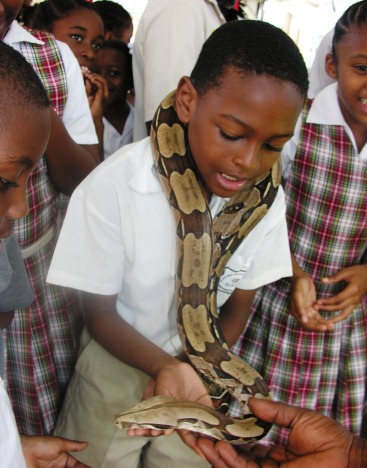
The Open Day was well received by all, especially the children who were most impressed with our “Mini Petting Zoo” which was provided by the Zoological Society of Trinidad and Tobago.