Showing posts with label UNFCCC. Show all posts

Wednesday, 20 March 2019

United Nations Framework Convention on Climate Change - Twenty Fourth Conference of Parties

The Twenty Fourth Conference of Parties (COP 24) of the United Nations Framework Convention on Climate Change (UNFCCC) convened in Katowice, Poland from November 28th to December 14th, 2018. COP 24 comprised preparatory meetings and meetings of various Constituted Bodies under the UNFCCC, running simultaneously. These were:
  • Preparatory meetings of the Alliance of Small Island States and G77 and China;
  • Twenty Fourth Conference of Parties (COP24) to the UNFCCC;
  • Fourteenth session of the Conference of the Parties serving as the meeting of the Parties to the Kyoto Protocol (CMP);
  • Third part of the first session of the Conference of the Parties serving as the meeting of the Parties to the Paris Agreement (CMA);
  • Forty Ninth Session of the Subsidiary Body for Implementation (SBI 49);
  • Forty Ninth Session of the Subsidiary Body for Scientific and Technological Advice (SBSTA 49); 
  • Seventh Part of the First Session of the Ad Hoc Working Group on the Paris Agreement (APA 1.7).

COP 24 was attended by over 22,000 participants, including nearly 14,000 government officials, over 7,000 representatives from UN bodies and agencies, intergovernmental organisations, and civil society organisations, and 1,500 members of the media. The Republic of Trinidad and Tobago was represented by Her Excellency Ambassador Pennelope Beckles, Permanent Representative to the United Nations, New York, Mr. Kishan Kumarsingh, Head, Multilateral Environmental Agreements Unit, Ministry of Planning and Development, Ms. Sindy Singh, Climate Change Specialist, Multilateral Environmental Agreements Unit, Ministry of Planning and Development.  

COP 24 was primarily focused on finalising the Paris Agreement Work Programme (PAWP), a set of decisions or “rules” meant to operationalise the Paris Agreement. At the end of the Conference, Parties adopted the Katowice Climate Package, which includes decisions on nearly all of the issues mandated as part of the PAWP. These include issues on guidance for Nationally Determined Contributions (NDCs), common timeframes, the impact of the implementation of response measures; guidance for adaptation communication, matters relating to the transparency of finance,  a new collective quantified goal on finance, issues related to the Technology Mechanism, and the technology framework,  procedures, and guidelines for the transparency framework for action and support, the global stocktake and issues related to compliance.

T&T Representatives - From right, Her Excellency Ambassador Pennelope Beckles, 
Mr. Kishan Kumarsingh and Ms. Sindy Singh

Her Excellency Ambassador Pennelope Beckles (right) and Ms. Sindy Singh (left) 
participate at the Gender Responsive Technology Needs Assessment Workshop

Wednesday, 12 December 2018

United Nation’s Climate Change Conference

The United Nations Framework Convention on Climate Change (UNFCCC) convened a climate change conference from September 1st - 9th, 2018 in Bangkok, Thailand to further negotiations under its constituted bodies, the Subsidiary Body for Implementation (SBI), the Subsidiary Body for Scientific and Technical Advice (SBSTA), and the Ad Hoc Working Group on the Paris Agreement (APA). Preparatory meetings for the Alliance of Small Island States (AOSIS) and the Group of 77 and China (G77 and China) met on August 30th - 31st, 2018 consecutively.

The three (3) subsidiary bodies which previously convened in Bonn in May, 2018 decided that an additional session was necessary to ensure the timely conclusion of negotiations towards achieving the Paris Agreement Work Programme (PAWP). The negotiations at this session were largely focused on advancing work on the PAWP, a set of decisions that will operationalise the Paris Agreement and facilitate its implementation. The Paris Agreement entered into force on November 4th, 2016. The deadline set for the completion of negotiations for the PAWP is the Twenty Fourth Conference of Parties (COP 24) to be convened in Katowice, Poland in December 2018. 

The key focus of these meetings was to advance discussions on several items under the subsidiary bodies as well as all issues under the Ad Hoc Working Group on the Paris Agreement. These include: mitigation, adaptation, finance, transparency, the global stock take, response measures, market and non-market approaches, compliance with, and implementation of the Paris Agreement; and possible additional PAWP items, including matters related to the Adaptation Fund, loss and damage and preparation for the convening of the Twenty Fourth Conference of Parties (COP 24) of the UNFCCC and its various related meetings. At the end of the session, a compilation of documents was published known as the “Bangkok Outcome” which reflects the status of negotiations on the PAWP at the Bangkok session.

Approximately 1,600 participants including nearly 1,200 government delegates and 400 representatives from United Nations (UN) bodies and agencies, intergovernmental organisations, civil society organisations and media representatives attended these meetings. Trinidad and Tobago was represented at these meetings by Mr. Kishan Kumarsingh, Head, Multilateral Environmental Agreements Unit (MEAU), Ministry of Planning and Development (MPD) and Ms. Sindy Singh, Climate Change Specialist, MEAU, MPD.


T&T Representative - Ms. Sindy Singh

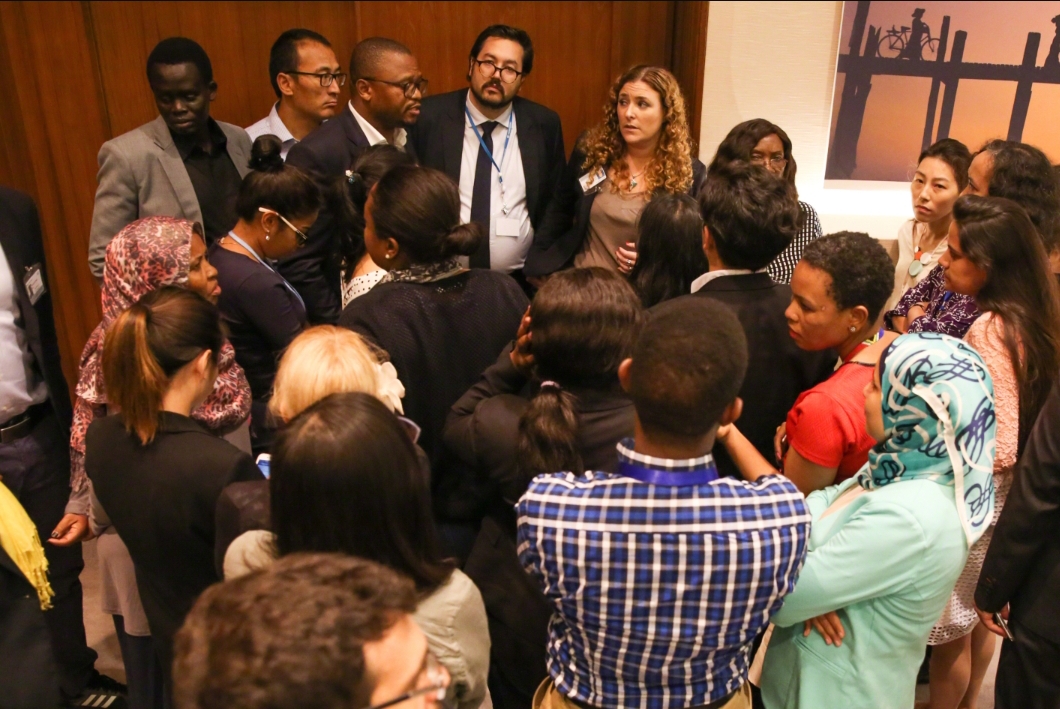
Ms. Sindy Singh participates at the G77 and China Huddle on
Climate Change Adaptation Communications


Friday, 27 May 2016

Bonn Climate Change Conference


The Bonn Climate Change Conference of the United Nations Framework Convention on Climate Change (UNFCCC) convened from 16 - 26 May, 2016 in Bonn, Germany. 

The Conference encompassed the 44th sessions of the Subsidiary Body for Implementation (SBI-44) and the Subsidiary Body for Scientific and Technological Advice (SBSTA-44), and the first meeting of the Ad Hoc Working Group on the Paris Agreement (APA-1). Preparatory meetings for the Alliance of Small Island States (AOSIS) and the Group of 77 and China on 12-13 May, 2016 and 14-15 May, 2016 consecutively.
 

SBSTA-44

The key focus of SBSTA-44 was to:
  • continue its work on the methodological issues under the Convention, the Kyoto Protocol and the Nairobi Work Programme on impacts, vulnerability and adaptation to climate change (NWP)
  • initiate work on matters mandated by the Paris Agreement including the on the technology framework and modalities for Article 6 of the Agreement (which relates to cooperative approaches and the framework for non-market approaches).

SBI-44

 SBI-44 focused on: 
  • continuing  its regular work on implementation, including on mechanisms under the Kyoto Protocol, capacity building, gender, and national adaptation plans (NAPs) 
  • initiating work on matters mandated by the Paris Agreement including the development of modalities and procedures for a public registry for Nationally Determined Contributions (NDCs), and for adaptation communications.

APA-1 

The main intent of APA-1 was:
  •  adopting a programme of work as mandated by the Paris Agreement
  • coming to conclusions to further work on guidance for mitigation
  • determining guidance for NDCs including information to facilitate their clarity, transparency and understanding and accounting for NDCs as well as further guidance for adaptation communications and for the transparency framework;
  • discussing matters relating to the global stocktake; including potential modalities as well as  modalities and procedures for compliance; and preparation for the entry into force of the Paris Agreement.

Tuesday, 23 February 2016

Air Pollution Rules - Chamber of Industry and Commence Breakfast Meeting


The Multilateral Environmental Agreements Unit (MEAU) of the Ministry of Planning and Development to participate at Breakfast Meeting arranged by the Chamber on Friday 19th February, 2016 at the Chamber’s Westmoorings offices. 
"The APR 2014 is legislation developed under the Environmental Management Act Chapter 35:05 designed to manage the levels of specific air pollutants known to cause harm to human health and the environment, thereby improving overall air quality. To this end, prescribed standards for air pollutants in Ambient Air (Schedule 1) and for the release of air pollutants at distinct points (Schedule 2) have been established. Therefore, the main objective of the meeting was to sensitise the members of the Chamber and the wider business community, of the requirements of the Air Pollution Rules, 2014."                                                                                                                                                                                                      Source: http://www.ema.co.tt/new/index.php/legal/legislation/air-pollution

Among the presenters at the Meeting which included the Environmental Management Authority (EMA), was Mr. Kishan Kumarsingh, Head of the MEAU.

 
He presented on the Potential Role of the APR 2014 in implementing the recent Paris Agreement which came out from the twenty–first Conference of Parties (COP21) to the United Nations Framework Convention on Climate Change which occurred in December, 2015.


Monday, 14 December 2015

COP 21 Climate Change Conference

The Paris Climate Change Conference convened from 29 November to 13 December 2015, in Paris, France. It included the 21st session of the Conference of the Parties (COP 21) to the United Nations Framework  Convention on Climate Change (UNFCCC) and the 11th  session of the Conference of the Parties serving as the  Meeting of the Parties to the Kyoto Protocol (CMP 11).

Three subsidiary bodies (SBs) also met, the 43rd sessions of the Subsidiary Body for Scientific and Technological Advice (SBSTA 43) and the Subsidiary Body for Implementation (SBI 43), and the 12th part of the second session of the Ad Hoc Working Group on the Durban Platform for Enhanced Action (ADP 2-12).


Trinidad and Tobago participated in this monumental COP. The country was represented by the H.E Ambassador Eden Charles  Charge d' Affaires a.i. Permanent Mission of the Republic of Trinidad and Tobago to the United Nations as well as staff of the Multilateral Environmental Agreements Unit (MEAU) of the Ministry of Planning and Development; Mr. Kishan Kumarsingh (Head) and Ms. Jewel Batchasingh (Climate Change Specialist).


H.E. Ambassador Eden Charles delivering the country’s address at COP 21.


L-R: Ms. Batchasingh and Mr. Kumarsingh  participating at COP 21.

Focus in Paris centered on advancing negotiations on the Paris Outcome, including a legally-binding agreement and associated decisions, to fulfill the mandate outlined in Durban, South Africa, at COP 17, for the ADP “to develop a protocol, another legal instrument or an agreed outcome with legal force under the Convention applicable to all   Parties” to be adopted at COP 21.

Parties to the UNFCCC reached a landmark agreement on December 12 in Paris, charting a fundamentally new course in the two-decade-old global climate effort. Furthermore, the unprecedented showing of action and support from all levels of society was widely  credited as an important factor in Paris’ success. 


>> Information on COP 21 and the resulting Paris Agreement can found on the UNFCCC website.

Friday, 20 November 2015

T&T submits its INDC!

Countries across the globe have committed to create a new international climate agreement by the conclusion of the upcoming Conference of the Parties to the United Nations Framework Convention on Climate Change (UNFCCC) in Paris, November 30 - December 11, 2015.

In preparation, countries have publicly agreed to outline what post-2020 climate actions they intend to take under a new international agreement known as their Intended Nationally Determined Determined Contributions (INDCs). The INDCs will largely determine whether the world achieves an ambitious 2015 agreement and is put on a path towards a low carbon, climate resilient future. 

Trinidad and Tobago's INDC was submitted to the UNFCCC in August 2015, the first Caribbean country and second Small Island Developing State (SIDS) do so. It is based on the Caribbean Reduction Strategy which was developed for the major carbon emitting sectors of our economy, i.e. the power generation, transportation and industrial sectors. This process lasted 3 years and was finalised in 2014. 

The INDC for Trinidad and Tobago present buisness as usual (BAU) scenarios for the 3 emitting sectors up to the year 2030. It identifies mitigation options and includes policy instruments, knowledge and awareness approaches to elicit behavioural changes and direct technology intervention options such as clean technology, fuel switching and renewable energy and energy efficiency technologies. 

Trinidad and Tobago's aim is to achieve a reduction of overall emissions from the 3 sectors by 15% by 2030 from BAU equating to 103,000,000 CO2e. The estimated cost of meeting this objective is 2 million USD and is expected to be met partly through domestic funding and conditionally on international financing including through the Green Climate Fund.

Click here the following link to read the Trinidad and Tobago's INDC!